




Jessica Lamber explores what she learned from the Museum’s Association Conference 2016, Glasgow.
On the 7th November Holly and I travelled up to the Museum Association Conference 2016 in Glasgow. We were both looking forward to the networking opportunities and finding out about interesting projects going on at other institutions around the world. Could any of these help us at BCLM?
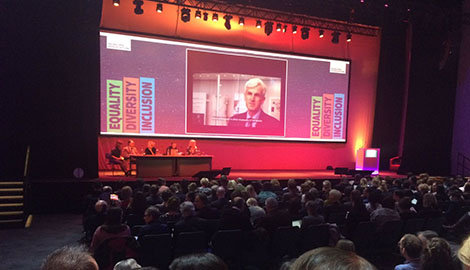
We arrived at the Scottish Exhibition and Conference Centre (SECC), which is locally known as the armadillo although it also resembles a small part of the Sydney Opera House. Immediately we made our way to the introduction speech given by the conference host Lesley Riddoch, a Scottish broadcaster and David Fleming, President of the Museum Association. They introduced to us the themes of the conference: Being Brave, Health and Wellbeing and People and Places. I felt that the People and Places theme was especially relevant for my role here at the museum –How is identity created and what role do museums have in creating identity? How can museums be used to create a sense of belonging across the diverse community groups we have in our local area? But it was a quote discussing the Health and Wellbeing theme that stuck with me:
If museums explore what it means to be human, then health and wellbeing should be at the centre.
David Fleming also introduced to us the House of Memories project going on at Liverpool Museums. It is a project that works with older people suffering from dementia. Using an app that contains photographs from the museum archives, dementia sufferers, their carer’s and museum facilitators can browse through until something sparks a memory. Resurfacing memories can be discussed and the important photos added to a memory tree that can be accessed at any point. The video showing the impact this had had on some of the users was very poignant and the key message of the conference – Museums Change Lives – was really brought home to me.
I went to six talks on the Monday ranging including how the National Trust of Scotland uses their Gaelic folk archive at Canna house as an active resource and how reflecting communities in our collections makes the museum part of that culture. But my favourite talk of the day was ‘It’s OK to Play”. As many of us know, children’s play is very important for childhood development. It teaches them how to build relationships, combat stress, engage socially and become resilient and confident and the right to play is part of the UN Convention of Rights of the Child. Museums are a great place for children to play as they are safe spaces with lots of things to inspire games. Speakers from the Eureka Children’s Museum and Play Torbay acted as case studies and they even got us involved by singing songs and creating our own museum quest which, for our group, involved the pirate Annie Bonnie fighting off a sea monster to collect her treasure. At Play Torbay, children themselves create the quests and are helped out by the museum staff and local artists. All the quests involve a linked craft activity, a challenge, song, dance and adventuring around the museum which was used as the stimulus to
Leave a Reply