
Category: Key update

  • Opportunity – Get involved in creating sustainable fashion!

    S4S Stitched-Up! Action for Sustainable Fashion is a community activism project run by S4S: a coalition of fashion designers, community groups, activists, academics and makers who are ‘Designing a Sensibility for Sustainable Clothing’ by promoting creative approaches to re-use, repair, recycling and sustainable design on a local, national and global scale.

    S4S Stitched-Up! are running workshops for a research project into sustainable clothing and are currently recruiting for people to take part on the project.  Participants will join  a series of workshops with S4S Stitched-Up! designers to learn new skills, share ideas, make, mend and generally get creative about sustainable clothing.  Workshop places are open to staff and volunteers at the Museum, travel expenses will be paid and there will be a reward of shopping vouchers for taking part in the research.

    BCLM is hosting five workshops on Fridays (day time) from 25 May and workshop participants will be working with vintage patterns and recycled fabrics to make clothing for the 1940s Weekend in July. The project group will explore the approach taken to clothes in the wartime years with the ‘Make do and Mend’ campaign.   Participants will be able to visit the museum during the 1940s weekend with a free day ticket on either 14 or 15 July to wear their newly created items in context .

    The project will ask participants to evaluate how taking part in the workshops has influenced the sustainability of their clothing choices.

    Places are limited so if you want to take part in this exciting project please contact Katie at [email protected] to secure your workshop place.

    S4S Stitched Up! is part of a research project called S4S – Designing a Sensibility for Sustainable Clothing and we are working in partnership with Exeter University and a community group in Penryn, Cornwall, who are also doing workshops. The website is currently under construction, but you can find more information on Twitter, Instagram and Facebook.

    Twitter: @S4sSensibility

    Instagram: s4s_sensibility

    Facebook: https://www.facebook.com/S4sSensibilty/
  • BCLM: Forging Ahead – Marsh & Baxters Call Out

    BCLM: Forging Ahead – Marsh & Baxters Call Out

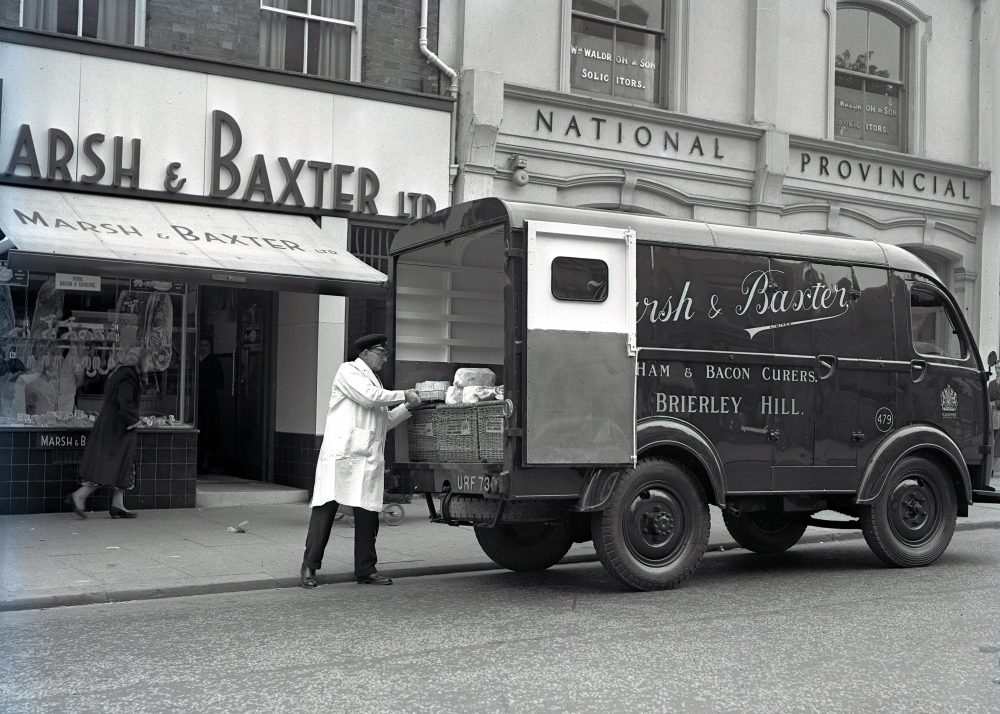
    We’ll be launching our public call-out for memories and objects relating to the Brierley Hill branch of Marsh & Baxter’s Pork Butchers’ Shop between the 40s-60s on Monday 16 April.

    Do have any personal stories about Marsh & Baxter’s? Did you or anyone in your family work in a Marsh & Baxter’s branch? Did you or your family shop there in the 1950s?

    If you, or anyone you know has anything you would like to share to help in our recreation of the Pork Butchers’ shop, inside and out, please pop in and see the Collections team in the Rolfe Street offices.


    A bit about Marsh & Baxter’s

    In 1871, Alfred Marsh purchased a butcher’s shop on Brierley Hill High Street and soon set about curing his own ham and bacon at a small factory nearby, in Hall Street. In the nineteenth century and well into the twentieth, the industry was very specialised: butchers might be general butchers selling beef and game, poulterers selling chicken, or pork butchers selling sausages, hams and other pork products. Marsh would have had plenty of competition: there were fifteen butchers’ shops in Brierley Hill alone in 1880.

    Marsh’s products proved very popular, and he soon looked to expand his business. He did this first of all by mechanizing his production process, introducing machinery and refrigeration to the factory to enable production of bacon, sausages, hams and pork pies on an industrial scale, all year round. In 1912, Marsh took over A.R. Baxter’s meat processing factory in Dale End, Birmingham and another five shops, gained a royal warrant, and rapidly grew into probably the biggest firm of its type in the country – even bigger than its local competitor, Dudley Port’s Palethorpes. The Hall Street factory grew to dominate the Brierley Hill skyline and provided work for thousands of locals: it had ten curing houses with a capacity of 60,000 hams, an ice plant, a huge fleet of delivery vehicles, and dedicated tunnels from the Stourbridge Canal and the firm’s own railway siding, through which pigs arrived.

    We will be recreating the smaller of Marsh & Baxter’s two butchers shops in Brierley Hill, from 70 High Street – a typical store, set in the early 1950s while meat was still rationed.


    Why Marsh & Baxter’s?

    Meat rationing began during World War Two and was the last item to be taken off ration in 1954. Nevertheless, the firm prospered: by the 1950s, Marsh & Baxter had 52 outlets and exported nationally and internationally, and were even one of the earliest firms to adopt television advertising. Their newspaper and billboard adverts were all over the Midlands too, especially the prize pig “drawing his own conclusion”: the “world’s best sausages.” The factory was a major loss for Brierley Hill when it closed in 1978, and the shops sold off.

    Upon its opening in 2022, visitors will be able to learn about rationing, the history of the firm and of food production in the Black Country – and try freshly-made pork pies and faggots.

  • For Information – Partnership with Black Country Touring

    As part of the Museum’s National Portfolio Organisation funding, we are developing a partnership with local touring theatre company, Black Country Touring – you may remember we hosted them last summer for their Life’s a Beach project. We will be working with Black Country Touring both at the Museum and across the Black Country to share the stories of our local communities through performance and first person interpretation.

    Over the next few months, during the development phase of BCLM: Forging Ahead, members of Black Country Touring will be working with various Museum staff, volunteers and consultants to explore the potential for theatre, performance and first person interpretation on our site. The first pilot performances will be devised and integrated into August’s Summer Evening programme, in some of our shops with the aim of developing this into a wider performance involving pieces onsite and in shops across the Black Country.

  • For Information – A National Portfolio Organisation 2018-2022

    For Information – A National Portfolio Organisation 2018-2022

    As of 1 April 2018, we are officially an Arts Council England (ACE) National Portfolio Organisation (NPO). This follows three successful years as an ACE-funded Major Partner Museum (MPM).

    We’ll receive £550,000 for each of the four years of investment, a significant amount of which will support our major development project BCLM: Forging Ahead including the growth and development of our STEAM (Science, Technology, Engineering, Art & Maths) Learning Programme and Community Engagement Programme with communities across the Black Country.

    We’ll also continue to lead the successful Museums & Resilient Leadership programme from 2018-2022.

    Our move to an NPO brings with it several staff changes:

    Hayley McCafferty-David, recruited as MPM project Manager in 2015 now moves fully into her role as BCLM: Forging Ahead Project Manager.

    Glenis Williams, recruited under the MPM programme in 2015 to help fulfil the Museum’s audience development objectives now moves into her role as full-time Community Engagement Manager to continue working towards widening participation with specific communities as part of BCLM: Forging Ahead. Glenis will also be interviewing shortly for a new Community Engagement Assistant to support in the delivery of this important work. More to follow once that appointment has been made.

    Dianne Rivers, recruited as MPM Volunteer Coordinator now moves into a Volunteer Manager role to continue to develop our growing volunteer programme. Ricki Boden also continues with us as Volunteer Team Administrator.

    Each of these members of staff have contributed so much to the Museum over the last three years and I’m delighted that we are able to retain their abilities as we move to a National Portfolio Organisation.


    The Museum’s success in becoming an NPO also sees Grant Bird’s appointment to a new Audience Analyst position. Grant is a very experienced market researcher, having spent more than fifteen years in consumer research prior to his current role as Curator (Domestic & Cultural Life). He will be starting in his new position on Monday 9 April. In addition to his substantive role as Audience Analyst, Grant will also be taking on some additional responsibility as manager of the Marketing & Communications team during Catherine Furnival’s maternity leave.


  • Rationalisation of Tram Collection – update

    This update follows the news article posted in December regarding the deaccessioning of four tram bodies under tarpaulins by the Albion Depot:

    Tram 361 (1998/036/001) ex Lisbon Tramways

    In line with the MA Code of Ethics/Disposal Toolkit and after being offered to any other Museum that would be interested in acquiring it for their collection, this week we said goodbye to Tram 361.

    Built in 1906 by J Stephenson Co, New York, single-deck Tram No,361 was delivered to the Lisbon Tramway Network (Rede de eléctricos de Lisboa) in 1907. Heavily rebuilt in 1947-49 and again in 1959-61, it survived in service until the mid-1990s. Acquired by the museum in 1998 the intention was to strip the vehicle for spares, with the bogies, brake gears and linkages deemed appropriate for reuse on Tram 49. Unfortunately this proved not to be the case and after being advertised to museums and heritage organisations both in the UK and abroad, the tram is heading back to Portugal and a new life with Paulo Marques, restorer of Lisbon Trams.


    The area outside Albion depot will continue to be tidied up over the weeks ahead, where only one covered Tividale built tram body now remains.

  • John Hughes Staff Award – Applications Open

    The John Hughes Staff Award is available to support the professional and personal development of individual(s) through funding for qualifications, conferences, workshops, short courses and research trips.

    The award is available to permanent staff members who have worked at BCLM for a minimum of 6 months and who are able to demonstrate how the award will support their personal development and also benefit the Museum.

    The maximum award available each year from 2016-2021 is £1,000 (the minimum amount requested should be no less than £200), which will be awarded to one or multiple staff members following submission of the attached form. (Any supporting or additional information about the professional/personal development opportunity should be attached to the application).

    There is still an amount of the 2018 funding available so we are seeking applicants to be considered for the funding.

    Staff are required to discuss their requirements with their Line Manager prior to completing the application form (available in the HR section of the Documents tab above). This is to ensure the application is suitable to be funded in this way and is not a requirement which may be able to be met by the Museum in other ways. This should then be authorised by the Line Manager and submitted to HR. A decision will then be made by HR and the relevant Deputy Chief Executive (s), subject to the remaining funds available and according to the needs of the Museum at that time.


    Please note the following:

    • More than 1 submission for funding may be made but priority may be given to first time applicants, depending on the nature of the application and the requirements of the Museum at that time.
    • If you leave BCLM within 12 months of receiving the award, you may be required to repay the amount received.


  • AIM Annual Conference – Opportunity to Attend

    The AIM annual conference this year takes place at the British Motor Museum, Gaydon across the two days of 21 and 22 June 2018.

    The theme for 2018 is ‘Changing Gear’. Day 1 will draw on important new research exploring how museums can attract more diverse audiences for the benefit of everyone whilst on day 2 finance will be the focus and will include ideas on alternative income generation and inspirational ideas on financial leadership

    As in previous years we are offering 2 staff the opportunity to attend this year’s conference, with travel for each day provided. All you need to do is complete an application and provide us with some information as to how you think this will be of benefit to you in your role here at BCLM.

    More information is available on the AIM website.

    If you are interested in attending, please complete the application form (available in the HR section of the ‘Documents’ tab above) and return to [email protected] by 5pm on Friday 27 April 2018. Staff will be selected based on their application and informed in early May.


  • New Look Intranet Screen Display

    Notice something different?

    We’ve re-designed the way the intranet is displayed on communal staff screens so that the information is clear, up to date (and hopefully interesting!)

    You’ll notice a few new features too such as the integration of a weather widget, a BCLM social media feed and a local news & travel section.

    Hopefully, you’ll find this a much improved way to receive news and updates from across the Museum but if there’s anything else you’d like to see displayed or any suggestions for improvements, please do let us know by emailing [email protected]


  • BCLM: Forging Ahead – West Bromwich Building Society

    We’ll be launching our public call-out for memories and objects relating to the Cape Hill branch of the West Bromwich Building Society (WBBS) pre-1960 on Monday 5 March.

    Do have any personal stories about this WBBS branch that was at 31, Cape Hill, Smethwick (opposite the present-day branch)? Perhaps you held a savings account with them or got your first mortgage there? Or maybe your family or friends worked there?

    If you, or anyone you know has anything you would like to share to help in our recreation of the West Bromwich building Society, please pop in and see the Collections team in the Rolfe Street offices.

    We’re particularly keen to hear the memories of those who moved to Smethwick from outside the UK during this period. This was a time when housing was a political, economic and cultural issue and finding somewhere to live was often challenging. We are keen to hear how new arrivals found somewhere to live, how they saved to buy a home, and about the difficulties they faced. If you have a story to tell we would love to hear it.


    A bit about WBBS

    The West Brom was formed as the West Bromwich Permanent Benefit Building Society in 1849, at Paradise Street Methodist schoolrooms in West Bromwich. Societies like this were formed to enable the working classes to afford home ownership and in turn receive a vote, whilst sharing the profits of the venture. The Society grew in strength between the wars, opening a new headquarters, the “Home Of Thrift” in West Bromwich High Street, and branches in Handsworth, Smethwick, Great Bridge and Oldbury. By its centenary year in 1949, the West Brom had over 1.5 million depositors, still helping people to save to afford their own home.

    The building we are recreating from 31, Cape Hill, was built in the late nineteenth-century as part of the Post Office on the corner of Windmill Lane, and was taken over by the Building Society in 1931. They moved their Smethwick Branch from Waterloo Road to this more prominent site and refaced the building with a new stone façade. It remained open until around 1970, when the branch moved across the road to its present position.


    Why WBBS?

    Telling the story of the Society in this period will enable us to show the importance of mutual help and savings to the ordinary residents of the Black Country, and how central to everyday life the idea of home was.


  • BBC Cooking Show – Voluntary Opportunity for all Staff & Volunteers

    Fancy taking part in a prime time BBC cooking show at BCLM? Want to be cooked for? Happy to wear costume?

    A prime time BBC Cooking Show will be filming at the Museum on Monday 19th March and is looking for volunteers to get involved.

    You’ll be needed from 10.45am until 2pm and full instructions will be issued in advance.

    For now, please email [email protected] to register your interest by Wednesday 7 March.

    N.B You must be wearing period costume on the day in order to take part.