Category: Information Sharing

  • Annual Trustee and Staff Event – 31 May 2018

    Please find below some further details regarding the next Trustee & Staff Event on Thursday 31 May.


    Lead:                     Lowell Williams, Chair of the Board of Trustees.

    Attending:          Trustees and Staff.

    Trustees:

    • Jonathan Badyal
    • Duncan Bedhall
    • Dr Paul Belford
    • Dr Malcolm Dick
    • Parminder Dosanjh
    • Andrew Fry
    • Nicola Harding
    • Cllr. Patrick Harley
    • Nick Loveland
    • Cllr. Christine Perks
    • Fiona Toye (Deputy Chair)
    • Lowell Williams (Chair)
    • Mike Williams

    Purpose:            

    To provide an annual opportunity for the Board to set out, directly to staff, their most important                                      strategic issues, and for staff to be able to ask questions about them.

    To provide an opportunity for staff to meet Trustees, especially new members of the                                                            Board, and vice-versa.


    Format:             

    10 minute illustrated presentation by Lowell Williams about the role the Museum                                                                is playing in the regeneration of Dudley and the West Midlands, and Q&A about this                                                            topic.

    Round-table groups, each chaired by a Trustee, to discuss and answer questions                                                                     about strategic issues facing the Museum.


    Timings:            5:30pm – 6:30pm


    Location:           Hall 2, BCLM


    Next Event:        30 May 2019

  • BCLM: Forging Ahead – Elephant & Castle

    We’ll be launching our public call-out for memories and objects relating to the Elephant & Castle in the 1940s-60s next week (commencing 14 May).

    Do you have any personal stories about the pub which stood on the corner of Stafford Street & Cannock Road, Wolverhampton until it was demolished in 2001? Did you or your family and friends drink there? Play dominoes there? Or just use it as a meeting place?

    If you do have anything you would like to share to help in our recreation of the Elephant & Castle – one of the biggest recreations within BCLM: Forging Ahead -, please pop in and see the Collections team in the Rolfe Street offices.


    A bit about the Elephant & Castle

    The Elephant & Castle was the grand Edwardian pub that stood on the corner of Stafford Street and Cannock Road. There had been a pub on that corner since at least 1834, when Samuel Davis, maltster and retail brewer, was licensee. Situated on a main route into town, it must have been a popular coaching inn, and by 1905 its owners, Manchester Brewery Co. (at this point under the chairmanship of John Henry Davies, who also owned the newly-christened Manchester United Football Club), decided to demolish and rebuild it as a magnificent landmark for those coming into Wolverhampton. The pub was designed by J.F. Hickman and H.E. Farmer from Walsall – best known for their cinema and theatre designs – and constructed by Speake & Sons of Stafford Street, Wolverhampton. Its instantly-recognisable green and white frontage – a specialist form of ceramic brickwork known as faience – was constructed by the famous Gibbs and Canning of Tamworth, who built similar terracotta for the Natural History Museum and Royal Albert Hall in London, and well-known Black Country buildings like Horseley Heath Post Office, and the Midland Counties Dairy in Wolverhampton.

    In 1907, Manchester Brewery was taken over by North Worcestershire Breweries, who were in turn acquired by Wolverhampton & Dudley Breweries in 1910, making the Elephant & Castle part of the Banks’s estate. By this time, Wolverhampton & Dudley were rapidly becoming one of the largest breweries in the region, competing with Mitchell’s & Butler’s huge Cape Hill brewery in Smethwick, and William Butler’s Springfield Brewery in Wolverhampton, as well as the multitude of small breweries and home-brew pubs in the Black Country. They went on to acquire other breweries, such as John Rolinson and Sons of Netherton, and the famous Julia Hanson’s of Dudley.

    Little is currently known about The Elephant & Castle’s licensees in the post-war period. We believe that a Sydney Jones was in charge in the 1940s, and Doris May Davies in the 1960s.

    The Elephant & Castle was typical of Edwardian pubs, with a public bar for the working class, and a separate Smoking Room, with slightly higher prices, for the middle classes – that way, managers could drink in the same pub without having to mix with their employees! The pub’s clientele was diverse, however. Wolverhampton was home to many thousands of Irish immigrants during the nineteenth century, many living in the Stafford Street area, and this was reflected by the Elephant & Castle’s Derry-born publican Patrick O’Kane in 1891. After World War Two, as local firms struggled to find the labour they needed, the Irish again formed the largest group of incomers, but they weren’t the only ones: colonial and Commonwealth citizens from India, Pakistan and the Caribbean also heeded the call for workers, and drinkers from all of these nations could be found in the Elephant & Castle. The pub’s sad decline in later years was capped by its unexpected demolition in 2001 – shortly before it could be considered for listing.


    Why the Elephant & Castle?

    It allows us to tell a multitude of stories of Black Country life from the 1940s-60s, including class divisions in pubs, pub games, drinks and stories of migration.

    Upon completion in 2022, visitors will be able to experience life in the post-war by trying a pint in the public bar, retiring to the Smoking Room with a bag of scratchings, or by taking on the regulars at dominoes.


     

  • Update – Completed Maintenance Q1

    Update – Completed Maintenance Q1

    Each year, we set out a Planned Maintenance Programme to address identified issues that impact the visitor experience and the safe operation of the Museum.

    In the first quarter of 2018, the following planned maintenance tasks have been completed:

    Location Description Completed
    Bottle & Glass Replacement of first floor windows Feb-18
    Bottle & Glass Bracket to attach gas cylinders Mar-18
    Bottle & Glass Re-grout cellar floor and seal (floor to wet to seal) Jan-18
    Bottle & Glass Replace rotten door frame to ladies toilet Mar-18
    Hut 14 Completion of contracted works (full works to be complete June 2018) Feb-18
    Locksmiths Re-fit lead flashing above front door Mar-18
    Locksmiths Re-fix fire in kitchen Mar-18
    Morralls Plaster under side of stairs in store Feb-18
    Morralls Install floor to under stairs store Jan-18
    Rolfe Street Paint Entrance Corridor Jan-18
    Site Install dog facility areas (temporary) Mar-18
    Site Roads Tarmac repairs/replacement – Tram Crossing Jan-18
    Site Roads Pothole repairs Feb-18


    The full Planned Maintenance Schedule for 2018 can be found within the Museum Documents section of the intranet.

  • Opportunity – Get involved in creating sustainable fashion!

    S4S Stitched-Up! Action for Sustainable Fashion is a community activism project run by S4S: a coalition of fashion designers, community groups, activists, academics and makers who are ‘Designing a Sensibility for Sustainable Clothing’ by promoting creative approaches to re-use, repair, recycling and sustainable design on a local, national and global scale.

    S4S Stitched-Up! are running workshops for a research project into sustainable clothing and are currently recruiting for people to take part on the project.  Participants will join  a series of workshops with S4S Stitched-Up! designers to learn new skills, share ideas, make, mend and generally get creative about sustainable clothing.  Workshop places are open to staff and volunteers at the Museum, travel expenses will be paid and there will be a reward of shopping vouchers for taking part in the research.

    BCLM is hosting five workshops on Fridays (day time) from 25 May and workshop participants will be working with vintage patterns and recycled fabrics to make clothing for the 1940s Weekend in July. The project group will explore the approach taken to clothes in the wartime years with the ‘Make do and Mend’ campaign.   Participants will be able to visit the museum during the 1940s weekend with a free day ticket on either 14 or 15 July to wear their newly created items in context .

    The project will ask participants to evaluate how taking part in the workshops has influenced the sustainability of their clothing choices.

    Places are limited so if you want to take part in this exciting project please contact Katie at [email protected] to secure your workshop place.

    S4S Stitched Up! is part of a research project called S4S – Designing a Sensibility for Sustainable Clothing and we are working in partnership with Exeter University and a community group in Penryn, Cornwall, who are also doing workshops. The website is currently under construction, but you can find more information on Twitter, Instagram and Facebook.

    Twitter: @S4sSensibility

    Instagram: s4s_sensibility

    Facebook: https://www.facebook.com/S4sSensibilty/

  • Staff Consultative Forum- Elections

    The Staff Consultative Forum is now looking to elect new members. Would you like to be part of the forum and represent your colleague’s views in order to make a difference?

    If so why not put your name forward?

    We are looking for representatives in the following areas:

    • Administrative, Specialist & Managerial  x1        
    • Demonstrators    x1                                                       
    • Food & Drink, Retail & Admissions   x1                      
    • Learning  x1                                                                
    • Premises, Estates and Cleaning   x1                         

    Apart from the Chief Executive and members of the Senior Leadership Team, all employees, whether they are full-time, part-time, seasonal or casual, are eligible to stand for election as staff representatives.  Staff who are also members of a trade union can, of course, stand for election, but not in the capacity of a trade union steward, and as such, must represent the views of all of their constituents.

    The main duties and responsibilities of elected staff representatives include:

    • attending meetings of the Forum;
    • consulting with, and representing the views of their constituents;
    • reporting back to constituents Forum decisions and deliberations.

    Meetings take place quarterly are chaired by the Chief Executive.

    If you would like to be considered as a Staff Representative you will need somebody to propose your nomination and the name of another staff member who seconds your nomination. You will then need to complete and all sign the nomination form and either send it to Lucy Bennett, Head of Human Resources. [email protected] or leave in the HR pigeon hole in Rolfe Street or at Reception.

    All nominations must be received by 5 pm on Friday 11th May 2018.

    Once all nominations have been received, if we have multiple candidate nominations for a single role then elections will be held over the following two weeks, more details on this will follow.

    Unsure about which constituency you fall under? Check the Constituencies paper saved on the Intranet (Museum Documents/HR/SCF Constituencies).

    Nomination Form

  • New Volunteer section on Intranet

    We’ve introduced a volunteers area in the Museum Documents section of the intranet where you can find information about our volunteer programme, the opportunities available and the support we provide to volunteers.

    If you have any questions about volunteering please contact Di Rivers, Volunteer Manager or Ricki Boden Volunteer Team Administrator.


    Why volunteering matters

    The Museum grew out of community pressure in the late 1960s to ensure that the culture and traditions of the Black Country might be preserved. Volunteers then as now remain integral to achieving the Museum’s mission, “Inspiring your discovery of the Black Country”.

    Volunteering is an important expression of citizenship and is essential to democracy. It is a commitment of time and energy for the benefit of society and the community and can take many forms. It is undertaken freely and by choice, without concern for personal financial gain. (Volunteer England, Compact Code of Good Practice on Volunteering, 2005)
    Volunteering is a partnership between BCLM and the community, within which volunteers actively contribute to the Museum and the impact achieved for visitors. Volunteers provide time and in the case of some of the groups equipment and financial support.


  • Cleaning & Maintenance strike a pose

    Cleaning & Maintenance is the latest Museum team to adopt period costume.

    It’s been a challenge to find the team a costume that looks authentic and is practical to work in, both indoors and outdoors and in all types of weather!

    The men are wearing thick canvas trousers, grandad shirts, waistcoats and flat caps. The ladies have been provided with bib & brace, tan shirts, polos and head scarves to give a 1940s feel. All have work boots and for colder, wetter weather, wax jackets.

    The team love their new outfits.  We’re sure you’ll agree, they look fab!

  • BCLM: Forging Ahead – Marsh & Baxters Call Out

    BCLM: Forging Ahead – Marsh & Baxters Call Out

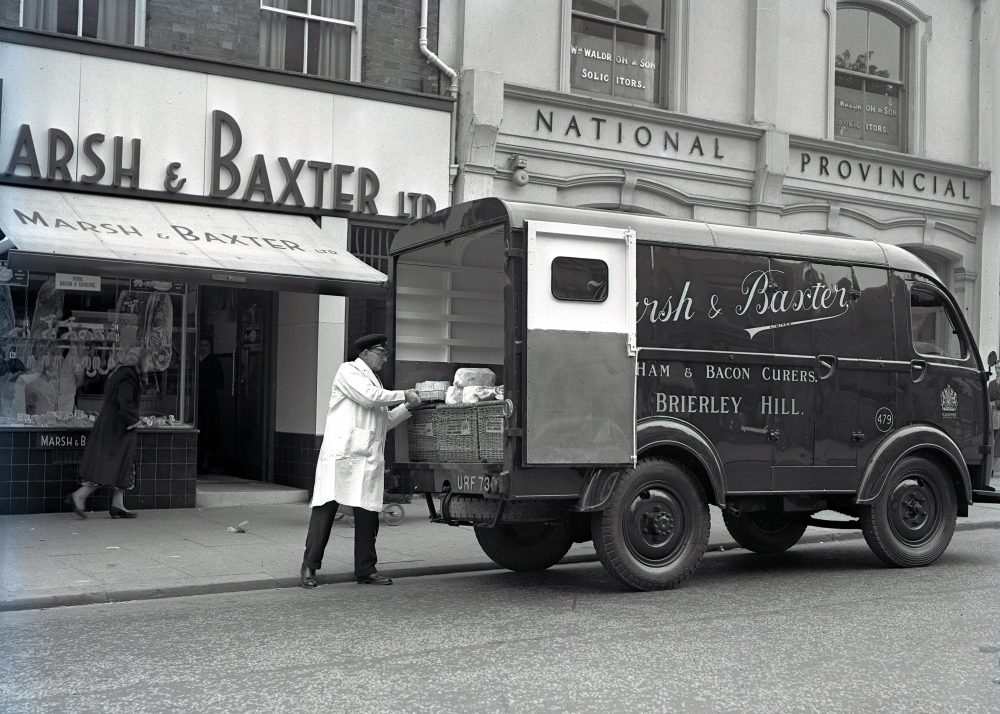
    We’ll be launching our public call-out for memories and objects relating to the Brierley Hill branch of Marsh & Baxter’s Pork Butchers’ Shop between the 40s-60s on Monday 16 April.

    Do have any personal stories about Marsh & Baxter’s? Did you or anyone in your family work in a Marsh & Baxter’s branch? Did you or your family shop there in the 1950s?

    If you, or anyone you know has anything you would like to share to help in our recreation of the Pork Butchers’ shop, inside and out, please pop in and see the Collections team in the Rolfe Street offices.


    A bit about Marsh & Baxter’s

    In 1871, Alfred Marsh purchased a butcher’s shop on Brierley Hill High Street and soon set about curing his own ham and bacon at a small factory nearby, in Hall Street. In the nineteenth century and well into the twentieth, the industry was very specialised: butchers might be general butchers selling beef and game, poulterers selling chicken, or pork butchers selling sausages, hams and other pork products. Marsh would have had plenty of competition: there were fifteen butchers’ shops in Brierley Hill alone in 1880.

    Marsh’s products proved very popular, and he soon looked to expand his business. He did this first of all by mechanizing his production process, introducing machinery and refrigeration to the factory to enable production of bacon, sausages, hams and pork pies on an industrial scale, all year round. In 1912, Marsh took over A.R. Baxter’s meat processing factory in Dale End, Birmingham and another five shops, gained a royal warrant, and rapidly grew into probably the biggest firm of its type in the country – even bigger than its local competitor, Dudley Port’s Palethorpes. The Hall Street factory grew to dominate the Brierley Hill skyline and provided work for thousands of locals: it had ten curing houses with a capacity of 60,000 hams, an ice plant, a huge fleet of delivery vehicles, and dedicated tunnels from the Stourbridge Canal and the firm’s own railway siding, through which pigs arrived.

    We will be recreating the smaller of Marsh & Baxter’s two butchers shops in Brierley Hill, from 70 High Street – a typical store, set in the early 1950s while meat was still rationed.


    Why Marsh & Baxter’s?

    Meat rationing began during World War Two and was the last item to be taken off ration in 1954. Nevertheless, the firm prospered: by the 1950s, Marsh & Baxter had 52 outlets and exported nationally and internationally, and were even one of the earliest firms to adopt television advertising. Their newspaper and billboard adverts were all over the Midlands too, especially the prize pig “drawing his own conclusion”: the “world’s best sausages.” The factory was a major loss for Brierley Hill when it closed in 1978, and the shops sold off.

    Upon its opening in 2022, visitors will be able to learn about rationing, the history of the firm and of food production in the Black Country – and try freshly-made pork pies and faggots.

  • BCLM Trustees – an update

    Following a recent recruitment drive to further strengthen the Board of Trustees, and interviews with the Chair, Lowell Williams, Deputy Chair, Fiona Toye, and myself, I am delighted to welcome 4 new Trustees to the Board.

    Jonathan Badyal, Head of Communications for Universal Music UK.  Jonathan grew up in Wolverhampton and previously worked as Policy & Communications Advisor to the Culture & Digital Economy Minister.

    Duncan Bedhall, Partner & Head of Commercial Property at Fisher German.  Duncan came from a family of chain makers from Cradley Heath and has a keen interest in British history.

    Councillor Patrick Harley, Leader of Dudley MBC, was nominated to the Board by the Association of Black Country Authorities, and is also a member of the West Midlands Combined Authority.

    Parminder Dosanjh, Creative Director for Creative Black Country.  Parminder has also worked for the BBC and Arts Council England, and is passionate about art, culture and community engagement.

    All 4 will bring a wealth of experience, knowledge and enthusiasm to the Museum.  Biographies and photos will soon be posted on the Museum’s website.


    Date for your Diary:

    We will be holding a ‘Meet the Trustees’ event for staff on Thursday 31 May 2018, at 5.30pm in Hall 2 (refreshments will be available).  Here you will have the opportunity to learn more about our Trustees and to ask them questions.  Sign-up sheets will be posted in staff areas soon, or you can let Jo know if you are able to attend.

    Andrew

  • Am I eligible for a tax rebate?

    If you wear a uniform at work, and have to wash, repair or replace it yourself, you may be able to reclaim £100s of tax for up to five years of expenses.

    Most people can claim back within the past four years, so back to 2014, plus the current year (five yeras altogether)- if you have been wearing the uniform all that time.

    A basic- rate taxpayer, claiming the standard uniform allowance for 2014-2018/19, could reclaim £60 in total.

    How to claim?

    Fill in the P87 form online at:  https://www.gov.uk/tax-relief-for-employees/uniforms-work-clothing-and-tools

    Alternatively you can contact HMRC on 0300 200 3310.

    Please note that this is something you will need to access yourself and not something that HR/ Finance will action on your behalf.