




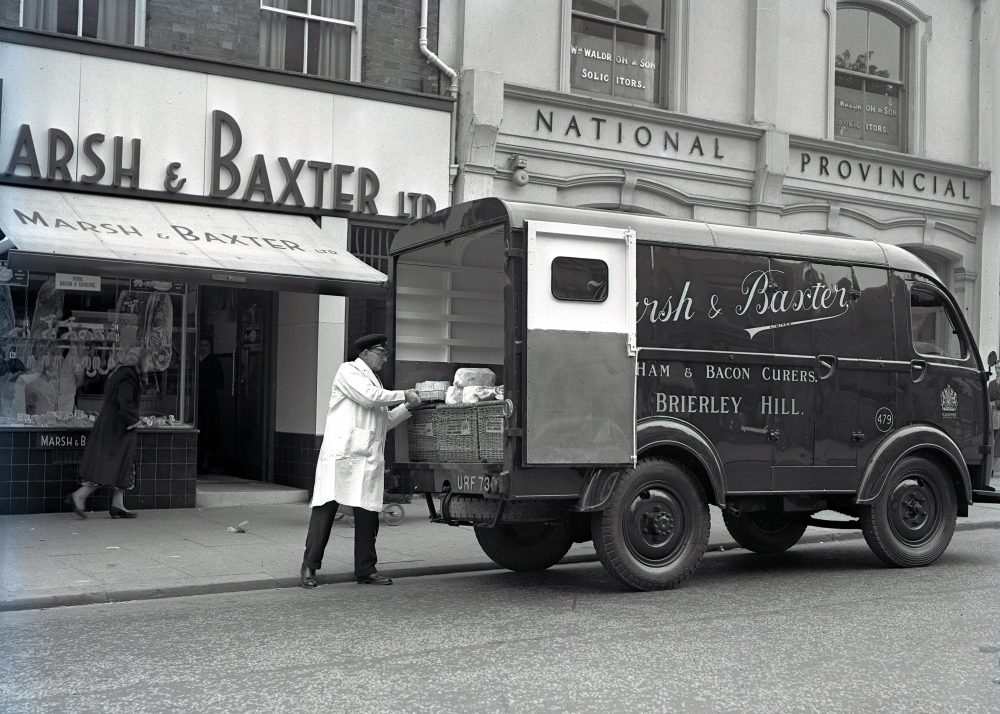
We’ll be launching our public call-out for memories and objects relating to the Brierley Hill branch of Marsh & Baxter’s Pork Butchers’ Shop between the 40s-60s on Monday 16 April.
Do have any personal stories about Marsh & Baxter’s? Did you or anyone in your family work in a Marsh & Baxter’s branch? Did you or your family shop there in the 1950s?
If you, or anyone you know has anything you would like to share to help in our recreation of the Pork Butchers’ shop, inside and out, please pop in and see the Collections team in the Rolfe Street offices.
A bit about Marsh & Baxter’s
In 1871, Alfred Marsh purchased a butcher’s shop on Brierley Hill High Street and soon set about curing his own ham and bacon at a small factory nearby, in Hall Street. In the nineteenth century and well into the twentieth, the industry was very specialised: butchers might be general butchers selling beef and game, poulterers selling chicken, or pork butchers selling sausages, hams and other pork products. Marsh would have had plenty of competition: there were fifteen butchers’ shops in Brierley Hill alone in 1880.
Marsh’s products proved very popular, and he soon looked to expand his business. He did this first of all by mechanizing his production process, introducing machinery and refrigeration to the factory to enable production of bacon, sausages, hams and pork pies on an industrial scale, all year round. In 1912, Marsh took over A.R. Baxter’s meat processing factory in Dale End, Birmingham and another five shops, gained a royal warrant, and rapidly grew into probably the biggest firm of its type in the country – even bigger than its local competitor, Dudley Port’s Palethorpes. The Hall Street factory grew to dominate the Brierley Hill skyline and provided work for thousands of locals: it had ten curing houses with a capacity of 60,000 hams, an ice plant, a huge fleet of delivery vehicles, and dedicated tunnels from the Stourbridge Canal and the firm’s own railway siding, through which pigs arrived.
We will be recreating the smaller of Marsh & Baxter’s two butchers shops in Brierley Hill, from 70 High Street – a typical store, set in the early 1950s while meat was still rationed.
Why Marsh & Baxter’s?
Meat rationing began during World War Two and was the last item to be taken off ration in 1954. Nevertheless, the firm prospered: by the 1950s, Marsh & Baxter had 52 outlets and exported nationally and internationally, and were even one of the earliest firms to adopt television advertising. Their newspaper and billboard adverts were all over the Midlands too, especially the prize pig “drawing his own conclusion”: the “world’s best sausages.” The factory was a major loss for Brierley Hill when it closed in 1978, and the shops sold off.
Upon its opening in 2022, visitors will be able to learn about rationing, the history of the firm and of food production in the Black Country – and try freshly-made pork pies and faggots.
Leave a Reply